

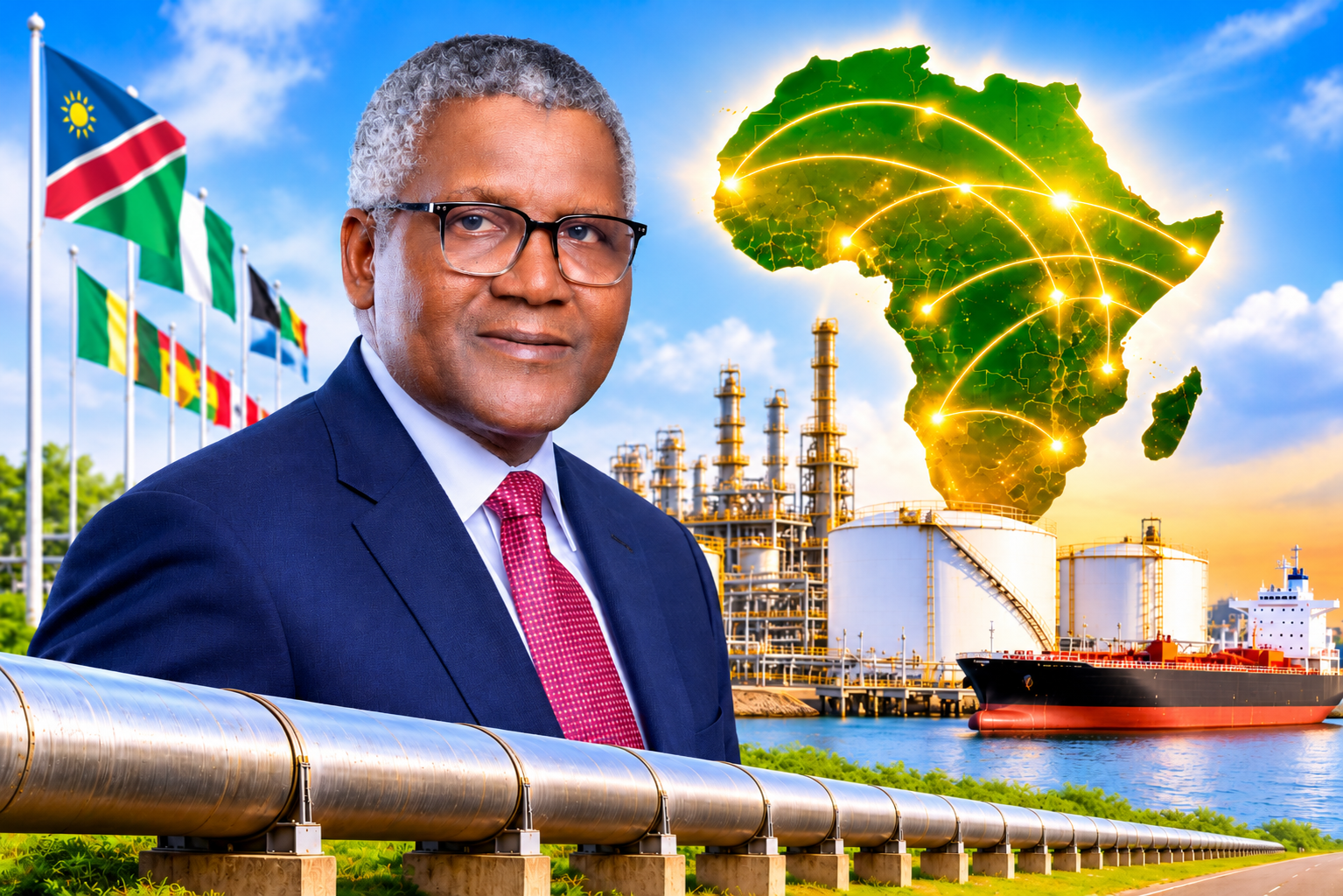
On November 4, 2026, Nigerian industrialist Aliko Dangote launched a US$2.5 billion petroleum storage and regional pipeline project in Walvis Bay, Namibia.
The proposed development features a massive 600-million-litre petroleum storage facility, comprising 360 million litres of diesel and 240 million litres of petrol. This represents approximately eight times the capacity of Namibia’s existing 75-million-litre National Oil Storage Facility.
At the heart of this investment is a proposed 1,700-kilometre regional petroleum pipeline, envisioned to transform Walvis Bay into a strategic Atlantic energy gateway and an integrated energy supply corridor connecting Namibia’s coastline to Southern Africa’s hinterland, including Botswana, Zambia, Zimbabwe, and potentially Malawi and the southern Democratic Republic of Congo, creating opportunities for a more integrated regional energy logistics network.
For these predominantly landlocked markets, the potential implications are enormous. They include diversified energy supply routes, reduced transportation and logistics costs, improved petroleum product availability, greater supply chain resilience, and enhanced competitiveness for industries that depend on reliable and affordable energy.
Importantly, this is not merely an investment in petroleum infrastructure. It is an investment in regional economic connectivity, energy security, industrial productivity, and Africa’s capacity to trade with itself.
Interestingly, this development comes at a particularly important moment in the global energy conversation, as world leaders, policymakers, and industry stakeholders convene for the 31st United Nations Climate Change Conference (COP31), taking place in Antalya, Türkiye, from November 9 – 20, 2026.
One of the critical issues emerging from the ongoing COP31 discussions is the need to reconcile global decarbonisation ambitions with the economic realities, energy security requirements, and development priorities of individual nations.
While the international community continues to advance the transition away from fossil fuels, there is growing recognition that countries face different starting conditions, institutional capacities, resource endowments, and economic dependencies.
For economies whose national revenues, employment, industrial activities, and foreign exchange earnings remain heavily dependent on fossil fuels, the transition presents considerably different challenges from those confronting countries with more diversified economies and established clean energy infrastructure.
This reinforces the importance of country-specific energy assessments and transition pathways, through which governments can evaluate their energy systems, economic structures, infrastructure readiness, financing requirements, and potential socioeconomic implications before implementing major transition policies.
The ongoing COP31 discussions, including Brazil’s proposed roadmap for transitioning away from fossil fuels and the emphasis on electrification, energy access, and affordable finance, further demonstrate that an effective energy transition requires more than ambitious targets
For Africa, this distinction is particularly important.
Our energy transition must be ambitious, but it must also be just, inclusive, economically realistic, and responsive to our industrialisation priorities.
This is where investments such as Dangote’s proposed Namibia project invite a broader conversation about the relationship between energy infrastructure, industrial development, and the global transition.
Speaking at the project’s launch, Dangote declared:
“Africa must industrialize Africa.”
He further emphasised that the continent possesses the resources, markets, talent, and entrepreneurial capacity to develop the infrastructure required for its transformation.
For decades, Africa has been richly endowed with natural resources while remaining disproportionately dependent on external markets for refining, processing, manufacturing, financing, and critical infrastructure.
We have historically exported raw materials, imported finished products, and surrendered substantial economic value along the way.
The development and operationalisation of the Dangote Petroleum Refinery in Lagos, Nigeria, represents an important departure from this historical pattern. It has significantly strengthened Africa’s refining capacity, expanded Nigeria’s potential as an exporter of refined petroleum products, and demonstrated the continent’s ability to undertake capital-intensive industrial projects at a globally competitive scale.
Beyond refining capacity, the facility creates opportunities for greater domestic value addition, improved foreign exchange retention, regional energy trade, and the development of supporting industrial value chains.
Africa should not be content with merely extracting and exporting its natural resources. We must increasingly develop the capacity to process, manufacture, distribute, and capture greater economic value from those resources.
Dangote’s expanding investment footprint across the continent offers an important perspective on what this ambition could look like.
In Kenya, the Dangote Group has outlined plans for another major refinery investment, signalling ambitions to strengthen refining and energy distribution infrastructure across East Africa.
In Ethiopia, its partnership with Ethiopian Investment Holdings is advancing a major urea fertiliser production complex in Gode. Initially announced as a US$2.5 billion investment, the project was designed with a planned annual production capacity of three million metric tonnes of urea, with subsequent announcements indicating an expansion of its investment scope.
Together, these initiatives illustrate an increasingly interconnected industrial strategy spanning energy, agriculture, logistics, manufacturing, and regional trade.
The African Continental Free Trade Area (AfCFTA) provides an important framework for unlocking these opportunities. Yet regional economic integration must move beyond agreements and policy declarations to the development of physical infrastructure that enables goods, energy, and services to move efficiently across borders.
Africa has the resources. Africa has the market. Africa has the talent. What we need is the sustained commitment to build.
Africa must not merely participate in the global economy. Africa must increasingly shape its own economic destiny.